
Connections / 2 min
Join two stacks with one tile
A single tile can connect two separate stacks. See why a blue 2 and blue 3 can Bloom with just one well-placed blue tile.
Your move
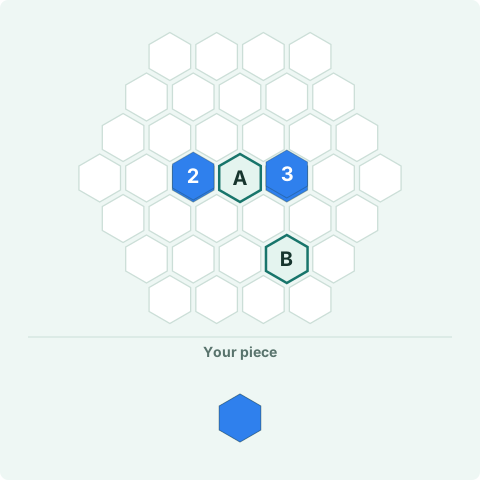
Where would you place the blue single: A or B?
The blue 2 and blue 3 are separate. A is the empty cell directly between them. B is an empty cell farther down the board. Both placements fit. Which one Blooms now?
Reveal the move & why it works
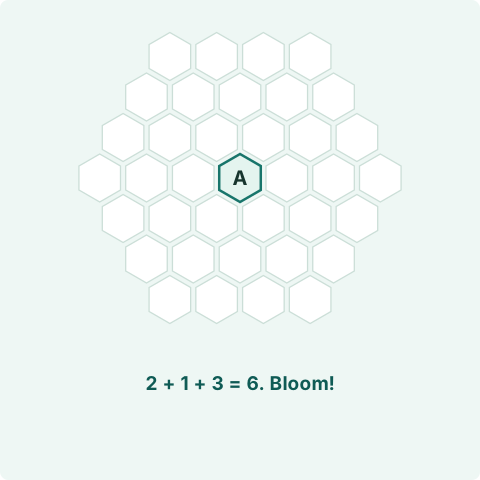
A joins both stacks.
Look for a shared empty neighbor
Two matching stacks do not need to touch each other yet. If they both touch the same empty cell, a matching single can connect them. Count all the connected tokens, including the new tile, before you place.
This is why a single can be valuable even beside a small stack. Here, neither 2 nor 3 is close to 6 on its own. The empty cell between them is what makes the move work.
A matching color is not enough
Color alone does not create a connection. A gap, another color, or a distant stack breaks the path. A blue piece elsewhere on the board will not pull these stacks across empty space.
A duo or larger piece can also create a bridge, but every tile in the piece must fit on an empty cell first. A Bloom that would happen afterward cannot make an occupied placement legal.
Check the space you get back
When the total stays below 6, one gathered stack remains and its source cells become empty. When the total reaches 6, the gathered stack clears too. In this example, the move leaves two more empty cells than you had before placing.
A total above 6 earns an Overbloom bonus, but waiting for one is a tradeoff. A Bloom you can make now may create room for a tray piece you would otherwise struggle to place.
Try it in your next round
Scan for two matching stacks with one empty neighbor in common. You do not have to play the bridge immediately. Just notice whether another move would fill that useful space.