
Stack position / 2 min
Read the + before you place
Use the + stack-point marker to predict where matching tiles gather. Work through a red-blue-blue piece beside an existing blue stack.
Your move
After this piece gathers, which tiles remain?
A red-blue-blue piece fits at the dashed outlines beside a blue stack of 3. The middle blue tile has the +. Predict the final blue count and its position. Does the red tile disappear too?
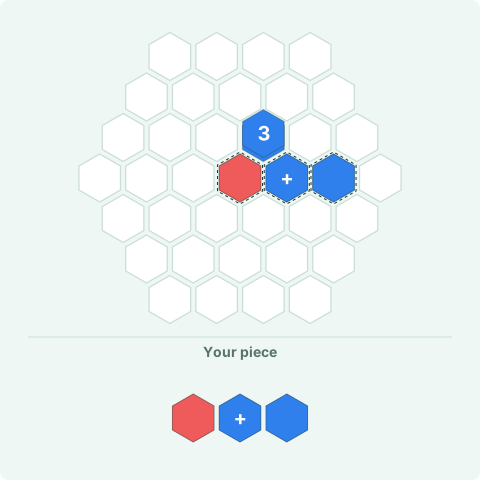
Reveal the move & why it works
Blue 5 stays at the +. Red stays separate.
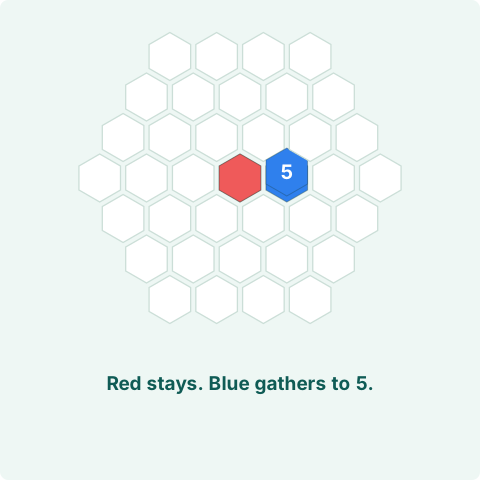
The + is a destination, not an extra point
The marker identifies a preferred gather point for a repeated color inside a piece. It does not add a token. Each newly placed tile still contributes exactly 1.
The same marker is visible while you drag. In this example, the piece begins with a red tile, but blue gathers at its own marked blue tile, not at the red tile or the old blue stack.
Mixed pieces have more than one job
A piece can help a blue stack while leaving a red tile behind. Think about both parts. The blue result may open space, but the remaining red tile can still block another shape or start a future red stack.
A piece with two repeated colors can have two + markers, one per color. Each connected color group resolves separately. A marker does not pull disconnected tiles through other colors or across a gap.
Read the final number and location together
A preview of 5/6 means that connected group will become a stack of 5. It still needs another matching token to Bloom. Here, aim the next blue tile at an empty neighbor of the new 5, not the now-empty cell where the old 3 stood.
A Bloom preview means the gathered total reaches at least 6. The tiles gather to one target before that target clears. Counts and empty spaces matter more than the size of the visual burst.
Try it in your next round
Before placing one mixed-color piece, predict which cells will still be occupied after the animation. Then compare your prediction with the result. This is a small way to practice planning without chasing a particular score.